Why Do Flat Roofs Leak? What Scottsdale Homeowners Should Know
Flat roofs are everywhere in Scottsdale's modern architecture, and for good reason, they're clean, striking, and make the most of a home's design. But flat roofs also fail differently than pitched roofs do, and understanding why is the first step to keeping your home dry.
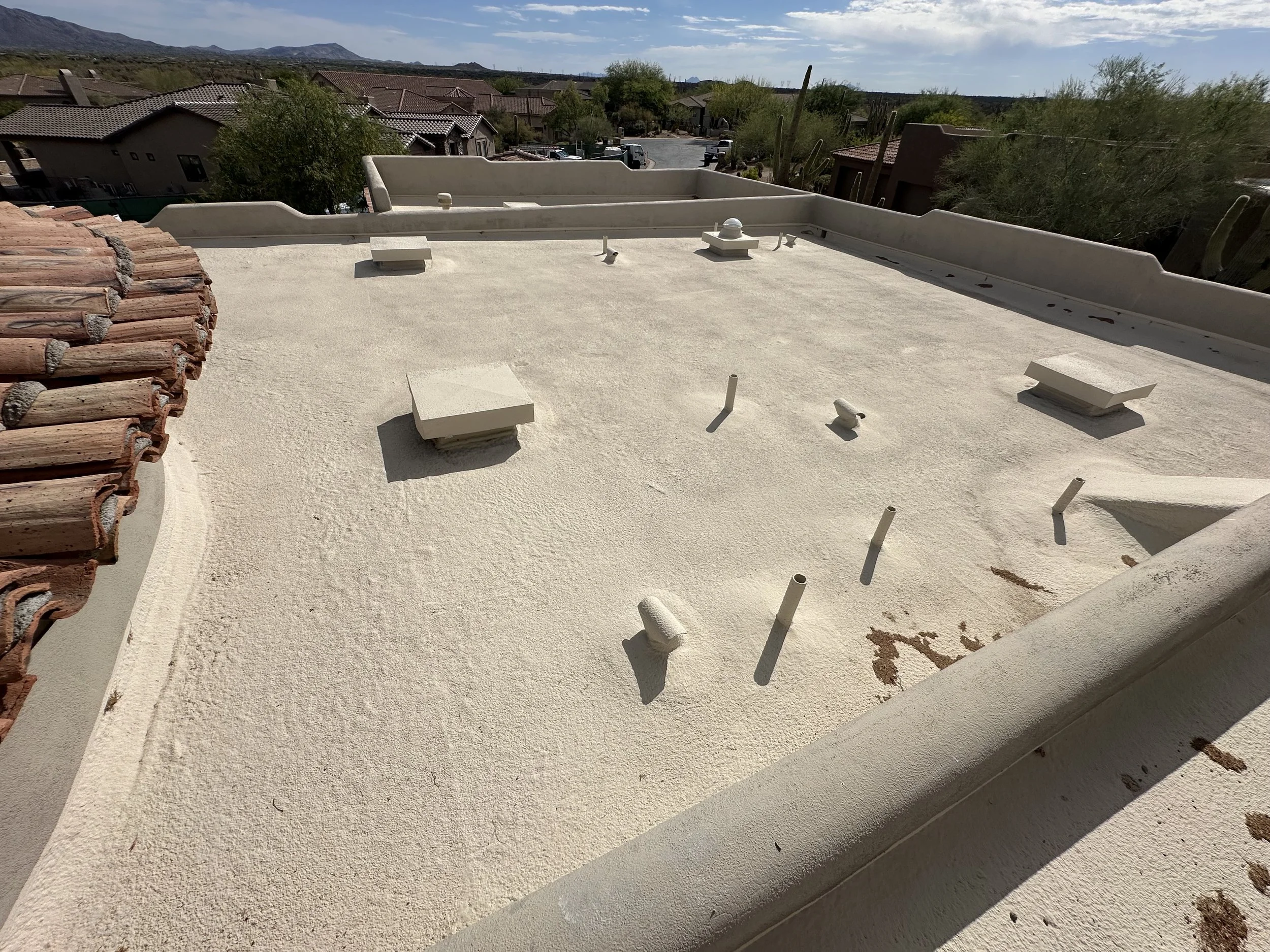
I'll say the quiet part first: if you've searched this, you probably already suspect the answer. Flat roofs are more prone to leaks than pitched roofs. That's not a knock on flat roofs, and it's not a reason to avoid them. I think they're beautiful. But it does mean they ask something different of you as a homeowner. A pitched roof sheds water almost by accident, gravity does most of the work. A flat roof has no such luck. Every drop of water that lands on it has to be told exactly where to go.
That difference is the whole story.
Where the Water Is Supposed to Go
A flat roof isn't actually flat. It's built with a very slight slope, usually a minimum of about a quarter inch of drop for every foot, so that water is guided toward a drain, a scupper, or the roof's edge instead of sitting in place. Building codes require this for a reason: without that built-in pitch, water has nowhere to go but down, into the roof itself.
When that slope is off, even slightly, or when a drain gets clogged, or when the roof deck has settled unevenly over time, water starts pooling instead of draining. Roofers call this ponding, and there's an industry rule of thumb worth knowing: water that sits on a flat roof for more than 48 hours is considered a real problem, not just an inconvenience.
Standing water on a flat roof can look completely harmless. The membrane may look fine. The water might only be an inch deep. But ponding is one of the most damaging conditions a flat roof can experience, because it works on every layer of the roofing system at once, not just the surface. The EPA specifically recommends designing roofs to avoid prolonged standing water for exactly this reason.
Why Standing Water Is So Damaging
Water sitting in one place for days at a time does a few things, none of them good:
- It breaks down the roofing membrane and its seams faster than normal weathering would
- It adds real weight to the roof, and that weight can cause the roof deck to sag slightly, which creates an even lower point for water to collect next time
- It creates the kind of consistently damp, shaded environment where algae and microbial growth take hold
- Eventually, it works its way through even a small crack or seam and becomes an interior leak
That last point is worth sitting with. By the time you see a stain on your ceiling, the water usually didn't just arrive. It's often been sitting on your roof, quietly working on the membrane, for a while before it finally found its way in. This is the same silent damage pattern I talk about often. The visible problem shows up last, not first.
One more thing most homeowners don't know: many roofing manufacturers will actually void the material warranty if they find evidence of ponding. It's considered a maintenance failure, not a defect.
Even a Good Roof Can Develop This Problem Later
Here's the part that surprises people. A flat roof can be installed correctly, with the right slope, the right drainage, everything done right, and still develop ponding years later. Buildings settle. Foundations shift slightly with age and ground movement. A roof deck that had perfect pitch on install day can end up with a low spot a decade later, simply because the structure underneath it moved.
This is exactly why proactive maintenance matters so much more for a flat roof than a pitched one. You're not just checking for damage. You're checking whether the roof can still do the one job a flat roof has to do every single time it rains, move water to where it's supposed to go.
Getting Water Off the Roof Is Only Half the Job
This is the part I think gets missed the most, and it's not really about the roof at all. It's about what happens after the water leaves it.
A flat roof needs a real exit system, an internal drain, a scupper, or a gutter, that actually carries water down and away from the building. Not just off the roof edge. Away from the house entirely.
If water is simply allowed to run off the roof and down the side of the building, you haven't solved anything. You've just moved the problem. Stucco is not a waterproof membrane. It's a coated, somewhat porous exterior finish, and it was never designed to have water running down it repeatedly. Runoff left to pour down a wall will soak in over time, leaving stains, encouraging mold, and slowly breaking down the stucco and paint. It's a genuinely common sight on homes around the Phoenix area, that faint discoloration running down from a roofline, and it's a visible sign of exactly this kind of water damage.
It also matters at ground level. Water that's allowed to dump right next to your foundation, rather than being carried a safe distance away, causes the soil around your home to swell and shrink with every rain. Over time, that movement can contribute to foundation cracking, a much more expensive problem than the roof that caused it.
You wouldn't leave a laptop sitting in a puddle and call it fine because the puddle is small. Water sitting on your roof, or running down the side of your home, works the same way. It doesn't need to be dramatic to cause real damage. It just needs time.
I bring this up because I think a lot of homeowners hear a roofer talk about drainage, scuppers, or downspouts and assume it's an upsell. Something extra. Optional. It isn't. This is the difference between a roof that sheds water and a home that actually stays dry. Those are two different things, and a flat roof only gives you the first one automatically.
What This Means for Your Home
None of this is a reason to avoid a flat roof. I genuinely love the way they look, and they're a completely viable, common choice throughout Scottsdale. It just means the relationship between you and your roof has to be a little more active. Flat roofs don't announce problems the way a missing shingle does. They fail quietly, through pooling you can't see from the ground and drainage that stops working exactly the way it's supposed to.
The homeowners who avoid real damage aren't the ones who never have an issue. They're the ones who caught it before it became one.
Frequently Asked Questions
How can I tell if my flat roof has a ponding problem?
Look for standing water more than 48 hours after a rain, dark stains or discoloration on the roof surface, or any blistering or algae growth in specific low spots. If you notice the same wet area every time it rains, that's a slope problem, not bad luck.
Is a little bit of standing water after rain normal?
Some water sitting for a few hours after a storm is normal and expected. It's water that lingers well beyond that, especially in the same spot every time, that signals a drainage or slope issue worth having looked at.
Do flat roofs need gutters?
Not necessarily gutters specifically, but they do need a complete drainage path. That means the roof itself needs proper slope toward a drain or scupper, and then a downspout or similar system to carry that water safely down and away from the house. Skipping either half of that chain causes problems, whether it's ponding on the roof or runoff damaging the walls and foundation below.
Can a flat roof that was installed correctly still develop drainage problems later?
Yes. Buildings shift and settle over time, and that can change a roof's original slope even years after a proper installation. This is part of why ongoing inspection matters, even for a roof that had no issues on day one.
Not Sure How Your Roof Is Actually Draining?
A flat roof can look completely fine and still be developing a drainage problem you can't see from the ground. If it's been a while since your roof was actually inspected, not just glanced at, we'd be glad to take a real look.
Book Your Free InspectionOr call or text us at 480.407.6000

Megan Graham brings a personal understanding of water damage and its effects on a home, shaped by her own experience living with hidden roof leaks. She writes to help homeowners recognize what's actually happening to their homes, with no fear-mongering, just clear, honest, actionable information.
This content is for general educational purposes only. Always consult a licensed roofing professional for evaluations or repairs specific to your home. Mastercraft Expert Roofing | ROC #361656 | Scottsdale, AZ | (480) 407-6000